

- by Vadym Chalenko
ROSÉ’s “New Trick” Music Video Shot Entirely on iPhone 18 Pro
- by Vadym Chalenko
ROSÉ is putting the new iPhone 18 Pro camera to work in a big way.
Her new music video, “New Trick,” was filmed entirely on iPhone 18 Pro as part of Apple’s latest Shot on iPhone campaign. Directed by acclaimed music video director Dave Meyers, the project gives us one of the first major looks at Apple’s newest camera system being used on a full-scale professional production.
The finished video is impressive on its own, but Apple’s official behind-the-scenes footage makes it even more interesting for filmmakers. It reveals a production filled with multiple iPhones, extensive lighting, gimbals, body-mounted cameras, grip equipment, rotating rigs, cranes, and some very creative ways of positioning such a small camera.
And, of course, we were excited to spot Beastcage being used in several of those setups.
According to Vogue, the entire “New Trick” music video was filmed using the iPhone 18 Pro for Apple’s Shot on iPhone campaign.
The video was directed by Dave Meyers, one of the most established names in music video production, with a career spanning projects for some of the world’s biggest artists.
For ROSÉ, the project also continues a long line of major music videos created as part of Shot on iPhone. Previous productions have included Olivia Rodrigo’s “Get Him Back!,” Lady Gaga’s “Stupid Love,” and The Weeknd’s “Dancing in the Flames.”
But “New Trick” is particularly interesting because it arrives alongside one of the biggest changes to the iPhone camera system in recent years: a variable aperture on the iPhone 18 Pro’s main camera.
And watching the finished video, there are plenty of situations where that expanded aperture range becomes genuinely useful.
One thing that immediately stands out in “New Trick” is the amount of intentional motion blur throughout the video.
Maintaining natural-looking motion blur generally means avoiding extremely fast shutter speeds, which creates a challenge when shooting in bright conditions. Traditionally, filmmakers solve that with neutral-density filters to reduce the amount of light reaching the camera.
Being able to close the iPhone 18 Pro’s main camera down to f/4 provides another level of physical exposure control.
That doesn't mean ND filters suddenly become unnecessary. Under bright daylight or powerful production lighting, f/4 alone may not provide enough light reduction to maintain the desired shutter speed. We also don't know exactly what filtration was used throughout the “New Trick” production.
But stopping down optically can reduce the amount of additional ND required, potentially allowing filmmakers to use less aggressive filtration while maintaining their desired exposure and shutter speed.
Images credit: Apple


At the opposite end of the range, f/1.48 becomes particularly valuable in low light.
“New Trick” contains numerous darker scenes and dramatically lit environments, and the results look beautiful. Opening the aperture allows considerably more light to reach the sensor, which can be extremely valuable when trying to preserve the atmosphere of a low-light scene without simply pushing sensitivity higher.
There are also numerous close-ups throughout the video with impressive subject separation and shallow depth of field. At close focusing distances, a wider physical aperture can help create stronger optical separation between the subject and background.
We don't know the exact aperture setting used for every individual shot, so we can't attribute every characteristic of the finished image directly to f/1.48 or f/4. But the video does a great job demonstrating the kinds of situations where having a real variable aperture on a smartphone camera can make a meaningful difference.
Images credit: Apple


Apple’s behind-the-scenes footage reveals another interesting detail: at least some of the production is shown being filmed directly through Apple’s native Camera app.
For professional iPhone filmmaking, that's worth paying attention to.
Third-party filmmaking apps have traditionally played an important role in providing deeper manual control over exposure, focus, frame rates, monitoring, and other camera settings.
With the iPhone 18 Pro, Apple has brought considerably more manual camera control directly into its native camera experience.
Seeing those controls being used on a production of this scale gives us an early glimpse at how Apple's native app can fit into a professional workflow.
Of course, the BTS doesn't establish that every shot in “New Trick” was recorded using the native Camera app. Other apps or workflows could have been used elsewhere during production.
What we can see is that Apple’s Camera app was part of the production toolkit.
Apple’s official BTS also gives us a fascinating look at just how extensively the iPhone 18 Pro was rigged throughout the shoot.
Naturally, we looked particularly closely at the setups using Beastcage, and there are several.
One of the clearest examples shows an iPhone 18 Pro inside a Beastcage mounted on a compact gimbal.
What's particularly interesting is how little equipment is actually attached directly to the camera.
What appears to be a single USB-C cable runs from the iPhone back to additional production equipment carried by a crew member.
Moving storage, power, monitoring, transmission, and other hardware away from the camera isn't anything new in professional filmmaking. But USB-C makes this kind of setup remarkably straightforward with an iPhone.
A single connection from the phone can potentially link it to external storage, power, monitoring, transmission, or other parts of the production workflow while keeping most of that equipment off the gimbal.
We don't know the exact signal chain or every device connected during the shoot, but the physical advantage is easy to see: the iPhone and gimbal remain incredibly compact.
That's particularly important because the small size of the camera is one of the biggest reasons to shoot with an iPhone in the first place.
Images credit: Apple


A behind-the-scenes photograph published by Vogue shows a completely different Beastcage setup.
ROSÉ is holding the “New Trick” lollipop while an iPhone inside a Beastcage is positioned directly in front of her on an articulating arm.
It's a relatively simple configuration, but a great demonstration of what becomes possible with such a small camera.
Instead of bringing a large camera body and support system into the space, the iPhone can be securely positioned exactly where the shot requires it, even extremely close to the performer or action.
Images credit: Apple & Kenneth Cappello


Apple’s BTS also shows Beastcage incorporated into a Snorricam-style body-mounted setup.
With this type of rig, the camera moves together with the performer, creating the distinctive effect where the subject remains relatively fixed in the frame while the environment moves around them.
This is exactly the kind of application where the physical size and weight of an iPhone become especially useful.
When the entire camera system has to move with the performer, keeping the camera itself small and lightweight can make the overall setup considerably more manageable.
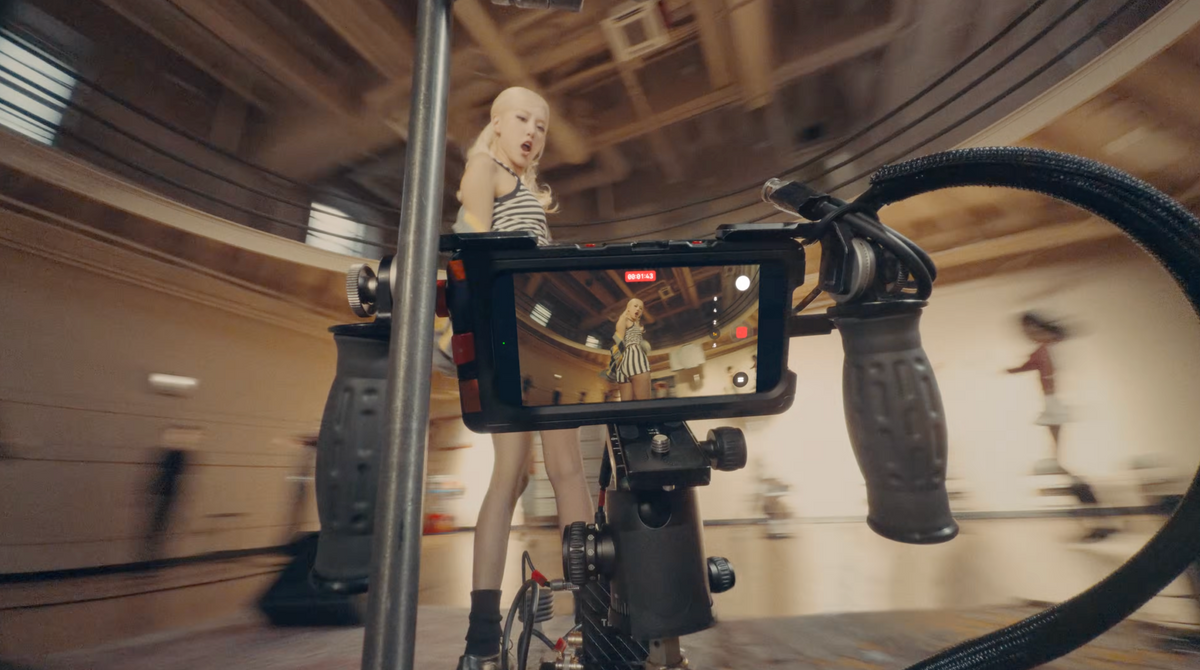
Another particularly interesting Beastcage configuration appears during a rotating shot around ROSÉ.
Here, the Beastcage is configured with handles attached through our RT and LT mounts with standard ARRI-style rosette connections. The camera assembly is then incorporated into a larger rotating platform rig that moves the iPhone around ROSÉ.
It's a great example of how such a small camera can be integrated into much larger, traditional production equipment.
The phone remains tiny, while the cage provides a rigid mechanical interface for handles, mounting hardware, and the larger rig surrounding it.
At the opposite end of the spectrum, Apple’s BTS shows one of the most impressive setups from the production: an iPhone 18 Pro mounted with Beastcage and Beastmod on a Matrix remote head and large camera crane.
The scale of the rig compared to the camera is almost surreal. At the center of this massive camera movement system is an iPhone.
This is also where Beastmod becomes particularly useful. Designed to expand Beastcage into a more complete filmmaking platform, it provides additional mounting and rigging options while keeping the iPhone securely integrated into larger production setups.
It’s a great example of the range we see throughout the “New Trick” BTS. The same iPhone 18 Pro and Beastcage platform can go from a compact gimbal or body-mounted rig to an articulating arm—and all the way up to a full-size crane and remote head.
The camera stays small. The rig can become as big as the shot requires.
Images credit: Apple


Apple’s BTS makes it clear that this was far from a single-iPhone, single-rig production.
Throughout the shoot, we see multiple iPhone 18 Pro devices used in a wide range of configurations, from relatively simple handheld setups to gimbals, body-mounted rigs, articulating arms, rotating camera systems, and much larger production equipment.
Different smartphone cages and mounting solutions appear along the way as the crew adapts the phones to the needs of the production.
And that's part of what makes the BTS so interesting to watch.
The iPhone's small size gives the camera and grip teams enormous flexibility in how and where a camera can be positioned, while cages and traditional grip equipment make it possible to incorporate those phones into more complex setups.
We're especially excited to see Beastcage appear repeatedly throughout that mix, from the compact gimbal and Snorricam-style rig to the articulating-arm setup and rotating camera system.
It’s a great look at what a large-scale iPhone production actually looks like behind the scenes: multiple phones, lots of rigging, and many different ways of getting the camera exactly where the shot calls for it.
There was one other thing in the finished video that immediately caught our attention.
Several shots clearly use a fisheye lens.
The extreme field of view, pronounced distortion, and exaggerated perspective are unmistakable, and the fisheye look is used creatively to give certain shots a completely different character.
Exactly which fisheye lens was used is another question.
We haven't seen a published lens list or a behind-the-scenes angle clear enough for us to positively identify the optic. So while we can see that fisheye optics were part of the creative toolkit, we can't confirm the specific lens or manufacturer.
As the people behind Beastgrip’s own smartphone fisheye lenses, you can probably imagine that we looked pretty closely.
For now, we'll leave it at that.
And that's part of what makes the BTS so interesting to watch.
The iPhone's small size gives the camera and grip teams enormous flexibility in how and where a camera can be positioned, while cages and traditional grip equipment make it possible to incorporate those phones into more complex setups.
We're especially excited to see Beastcage appear repeatedly throughout that mix, from the compact gimbal and Snorricam-style rig to the articulating-arm setup and rotating camera system.
It’s a great look at what a large-scale iPhone production actually looks like behind the scenes: multiple phones, lots of rigging, and many different ways of getting the camera exactly where the shot calls for it.
Images credit: Apple


Perhaps the most interesting part of Apple’s BTS is seeing everything happening around the iPhones.
There are substantial lighting setups, grip equipment, gimbals, body rigs, articulating arms, rotating platforms, remote camera systems, and a large professional crew making it all happen.
That's an important part of understanding what “Shot on iPhone” can look like at this level.
The iPhone 18 Pro is an increasingly capable filmmaking tool. Its new variable aperture provides another level of physical control over the image. The wider end of that aperture range becomes particularly valuable in low light and close-up work, while stopping down provides additional exposure control in brighter environments. The native Camera app now provides substantially more direct control, and USB-C makes connecting such a small camera to external production hardware surprisingly straightforward.
But none of that replaces filmmaking.
Lighting still matters. Camera movement matters. Rigging matters. Lens choice matters. Production design matters. And the people making all of those decisions matter most of all.
What the iPhone changes is the size of the camera at the center of that system.
It's small enough to mount directly to a performer, position inches away from the action, put on compact stabilization, or integrate into much larger production rigs—all while delivering an image capable of becoming the foundation of a major music video.
“New Trick” is a great example of what happens when those capabilities are placed in the hands of an experienced production team.
And seeing Beastcage used as part of several of those setups makes this one especially exciting for us.
Watch ROSÉ’s “New Trick” and Apple’s official behind-the-scenes video to see how it all came together.
iPhone 18 Pro & 18 Pro Max: Beastgrip Gear Compatibility & First Tests
Great news for iPhone 18 Pro and 18 Pro Max users: Beastgrip rigs, lenses, DOF Adapter MK3, and accessories are compatible and working great. Here’s a quick compatibility update, including Beastcage options and what we’re seeing from our first tests with the new variable aperture.
Read moreabout iPhone 18 Pro & 18 Pro Max: Beastgrip Gear Compatibility & First Tests
ROSÉ’s “New Trick” Music Video Shot Entirely on iPhone 18 Pro
ROSÉ’s “New Trick” was shot entirely on iPhone 18 Pro. Go behind the scenes to see Beastcage in action across gimbals, body rigs, creative camera setups, and more.
Read moreabout ROSÉ’s “New Trick” Music Video Shot Entirely on iPhone 18 Pro
iPhone 18 Pro Camera: What’s New for Mobile Filmmaking & Photography
Apple just unveiled the iPhone 18 Pro and Pro Max. We take a closer look at the new camera system, variable aperture, manual controls, performance upgrades, and what they could mean for mobile filmmaking, photography, and Beastgrip gear.
Read moreabout iPhone 18 Pro Camera: What’s New for Mobile Filmmaking & Photography


Share:
iPhone 18 Pro Camera: What’s New for Mobile Filmmaking & Photography
iPhone 18 Pro & 18 Pro Max: Beastgrip Gear Compatibility & First Tests